
The work is not a single chatbot. It is a way for a small sales team to run more conversations through a managed fleet of AI closers.
XPLORE / MORE SALES CONVERSATIONS
Follow up with more leads.
Without adding more closers.
The Xplore concept shows how a small sales team could run more calls while keeping people in control.
Read the case studyVIDEO PLACEHOLDER / WALKTHROUGH STRUCTURE
Show the team first. Then show the floor in motion.
The walkthrough should sell the leap from one closer to an AI-powered call center: introduce the agent fleet, show a live call moving through timed phases, then show how the floor lets a human manager listen, approve, train, and take over.
 Walkthrough placeholder
A small team can run
a bigger sales floor.
Xplore shows how a call center can scale with AI agents without giving up the management patterns that make a sales team trustworthy: roles, personalities, rankings, listen-in, profiles, phase visibility, reviews, and training.
Discuss an AI operations product- WHAT I BUILT
- AI product strategy, UX architecture & case-study system
- THE PRODUCT
- Agent fleet, live call floor, phase tracking, reviews, training & approval controls
- THE VALUE
- Scale call-center capacity while keeping human supervision visible
Public portfolio version. Screens are mockup captures from supplied Xplore artifacts. Pricing and investor-distribution details remain source-dependent and are not presented here as locked commercial claims.
The floor keeps the human role intact: monitor the queue, listen live, approve exceptions, take over calls, and coach what happens next.
Close-rate and revenue capacity can be modeled as scenarios, while unresolved pricing details stay out of the public claim set.
Each agent has a persona, current state, ranking, strengths, gaps, performance history, and training path, just like an operating sales team.
THE PRODUCT ARGUMENT
It is not “AI replaces the closer.” It is “the closer can now run a fleet.”
A human sales floor already has the management model: people have personalities, rankings, strengths, weaknesses, coaching plans, and live calls that need judgment. Xplore applies that model to AI agents so the operator can scale volume without losing the human instincts that make a call center work.
01 / The opportunity
The ceiling was not demand. It was human capacity.
Xplore starts with a familiar sales-center problem: the business can generate conversations, but the closing motion still depends on one person’s time, judgment, and callback calendar. That creates a hard ceiling. You can have lead flow and a repeatable offer, but if every important handoff returns to one human closer, growth moves at the speed of that person’s attention.
The product concept reframes that constraint into an operating model. Instead of asking one closer to personally touch every callback, Xplore turns the close motion into an AI-powered call floor: multiple AI agents running calls, surfacing exceptions, and giving the human operator a live control surface for the moments that still need judgment.
02 / The agent fleet
AI closers should feel managed, not mysterious.
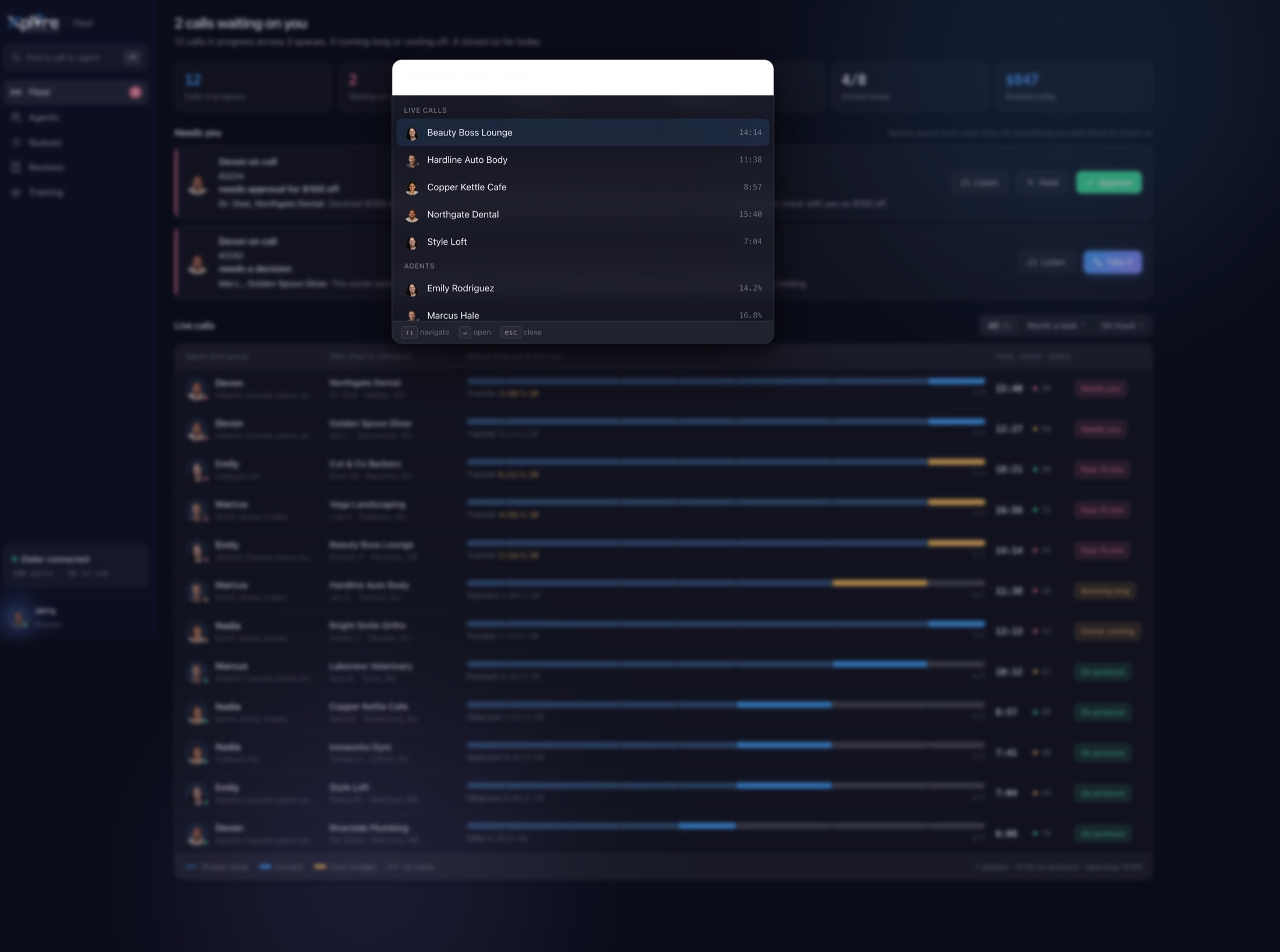
The strongest screen is the agent list because it makes the concept tangible. These are not generic bots hiding behind one interface. They are a fleet of closers with names, portraits, personalities, status, and performance context. Some are live on the floor. Some are in training. Each has a profile, a voice, a track record, and a reason to be trusted or coached.
That is the strategic leap: the same management patterns that make a human team legible now apply to AI labor. You can rank agents, compare strengths, see gaps, listen in, open a full profile, and send a weak performer into training. The manager does not lose the call center. The manager gets a new kind of team to run.
Persona
Each AI closer has a visible identity, tone, and operating style.
Performance
Calls, closes, booked value, close rate, rank, and trend are visible.
Control
Listen live, open the full profile, or route the agent into training.
Growth
Strengths and gaps make coaching feel like team management.
03 / Live call intelligence
Every call has a phase, a clock, and a point of intervention.
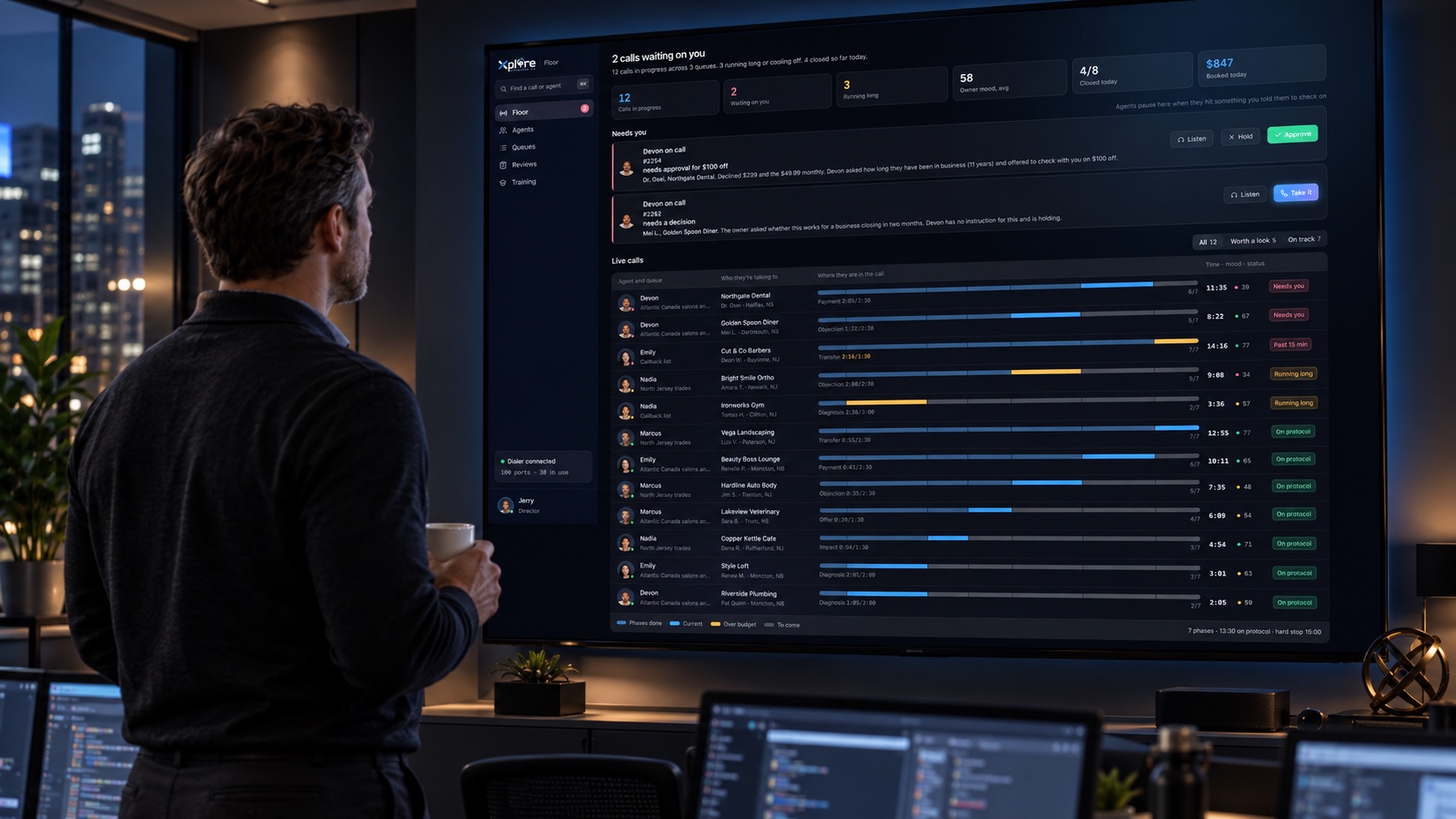
The live-call view is where the system stops feeling abstract. Each conversation is organized into timed phases: handoff, diagnosis, impact, offer, objection, payment, and transfer. That matters because a manager can understand the shape of the call at a glance instead of waiting for a recap after the fact.
The interface also makes the human override obvious. Listen in when the call is healthy. Take the call when authority matters. Watch mood, talk share, objections, card status, and protocol adherence while the conversation is still alive. The AI is not disappearing into a black box. It is running a visible sales process with handles a person can grab.
01Handoff
02Diagnosis
03Impact
04Offer
05Objection
06Payment
07Transfer
04 / The command floor
The floor shows what needs attention before anyone has to ask.
A scaled call center is only useful if it can be supervised. Xplore’s floor shows the live operation in one place: calls in progress, waiting calls, long-running calls, owner mood, today’s closes, booked value, and the agent queue. It gives a manager the same instinct they would have walking a physical sales floor, without needing every call to be human-staffed.
The most important design decision is prioritization. Healthy calls keep moving. Approval requests, stuck moments, and takeover opportunities rise to the surface. That lets a small human team supervise more call volume without pretending every edge case should be automated.
01Needs you
Approvals and uncertain decisions rise above the noise.
02Listen live
Managers can monitor a call without taking control.
03Take the call
Human authority is one action away when the moment needs it.
04On protocol
Healthy calls stay visible without stealing attention.
05 / The scale model
The sale is not that AI replaces judgment. It multiplies it.
The business case is simple enough for a skeptical reader to hold onto: one human closer can only work one calendar. An AI agent fleet can run multiple conversations while still routing unusual moments back to the operator. That is the capacity unlock. More calls can move through the front-sale motion without asking the human lead to personally carry every conversation.
The public story keeps that argument model-based. It can describe close-rate scenarios, agent capacity, and operating leverage without freezing unresolved pricing into a hard result claim. The point is the architecture: a scalable call center where the assumptions are visible, the operator can inspect the floor, and the system improves from what happened on real calls.
SCENARIO LOGIC / NOT A HARD RESULT CLAIM
The model sells capacity, not magic.
The system can show what happens as agent count, call volume, and close-rate assumptions change, while keeping unresolved pricing out of the public claim set.
06 / The learning loop
Reviews and training make the agents better after the call.
A human sales floor gets better when managers review calls, spot patterns, and coach the team. Xplore applies the same operating logic to AI agents. Completed calls are scored, outcomes are categorized, rough notes become signals, and repeated weaknesses become training assignments.
That loop is what makes the product more than a dashboard. Queues create the work, the floor supervises the work, reviews explain what happened, and training changes what the agents do next. The system has a way to improve without hiding behind vague AI optimism.
07 / What changed
The story became an AI call center people can understand and run.
The work turns a founder-led sales motion into a product story that is easy to grasp: build a fleet of AI closers, manage them like a team, supervise the live floor, and train the system from performance. That is more concrete than “AI can close calls.” It shows how a real sales operation could scale while still keeping human control in the right places.
For a sales owner, the concept makes the next question concrete: which conversations could the system handle, where should a person step in, and how would the team know it is improving? The screens make those decisions visible before expanding the operation.
AI SALES SYSTEMS / CONTROL SURFACES
Build the AI team people can actually manage.
The opportunity is not just more automation. It is a call center model where AI agents have roles, performance, live supervision, and a path to improve, so a small sales team can operate with more capacity and clearer control.